
“Hard to reach groups are not hard to reach – researchers just need to think outside the box in order to reach them and do things differently…”
Last Summer, Megan joined the team to take on a project to investigate effective ways of engaging the public in research, in particular with relation to researching inequalities in maternity health. You can read about Megan’s experiences in her own words here: Reflections on My Social Work Summer Internship | NCCDSW | Social Work Research.
It was a joy to support Megan in this project, not just because of her professional approach but also because of her enthusiasm for the task and the way she set about building relationships with colleagues and also with the members of the public who shared their views and experiences. The final report has now been completed and the thoughts shared by the participants were really helpful and will inform our research into the future.
The overarching global theme that was a golden thread throughout the conversations was not feeling valued or understood. The discussions often focussed on issues such as tokenism, meeting a ‘diversity’ goal and box ticking rather than researchers wanting to include them in a meaningful way. They spoke about being coerced into previous projects and often being the only person of colour or from an ethnic background. They recalled how meaningless it felt to be used as a reason to tick the diversity box and that during such experiences they started to question whether or not their viewpoint, knowledge and expertise would actually help answer the research question or whether they had just been included so that researchers could say they had a diverse group of people involved.
This led to discussions around the barriers that were often found such as location, access to support, ensuring that the focus group or interview was a safe space where they were heard and able to share their thoughts freely:
“Inclusion means more than presence; it means belonging and safety.”
With inclusive research feeling:
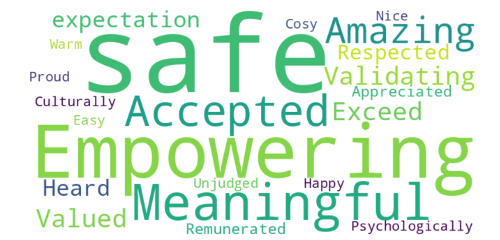
The role of the researcher as a facilitator was instrumental to proving this safe space, and it was important for them to have strong organisational and planning skills, as well as an understanding how to effectively facilitate conversations where everyone felt they could contribute, using core skills such as active listening and para-phrasing:
“Feedback as we are discussing (rewording what you said back to you) (validates what they said) and giving people time to think and speak.”
Overall, was the need for the research to be meaningful and for those involved to know the outcomes:
“Potential to retraumatise self by re-living the trauma when engaging in research for no change to happen.”